Classes of the Order

The Order of the Falcon has a notable history, and various rules apply to it, which are set out in the presidential decree concerning the order.
Original design
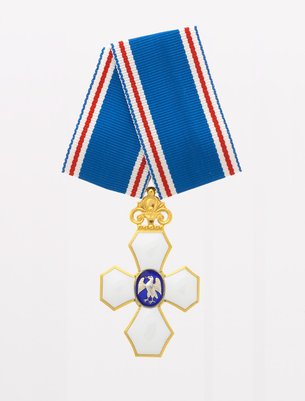
When King Christian X and Queen Alexandrine visited Iceland in the summer of 1921, a royal decree was issued establishing the Order of the Falcon, and the king became its first Grand Master. The common insignia of the Order of the Falcon was, and still is, a white-enamelled cross with gold edging and indented arms, the tips of which are cut off inward. At the center of the front of the cross is a blue-enamelled shield with a gold border, bearing a silver falcon with wings raised for flight. On the back of the cross, at the center, there was originally the king’s monogram with a crown above, gilded on white. Around the monogram was a blue-enamelled, gold-edged band, inscribed in gold letters: First of December 1918. The original decoration was designed by Hans Christian Tegner, professor at the Royal Danish Academy of Fine Arts in Copenhagen, in collaboration with Jón Hjaltalín Sveinbjörnsson, the king’s secretary, and Poul Bredo Grandjean, a heraldist. It is worth noting that a falcon appeared in Iceland’s coat of arms from 1903 to 1919, and falcons were considered splendid gifts for dignitaries in earlier centuries and were a valuable export commodity of Icelanders.

New grandmaster
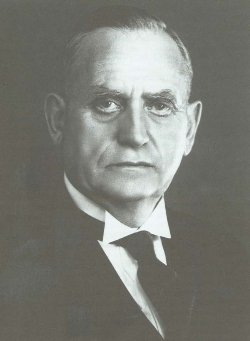
With the German occupation of Denmark on 9 April 1940, the conferral of decorations by the king was suspended, but on 17 January 1942 the regent of Iceland, Sveinn Björnsson, later president, issued a letter stating that his office would exercise the power to confer decorations and that the prime minister was to appoint a member to the Order Council in place of the Chancellor of the Orders, who was also the King’s Secretary. The first awards under these new rules took place the same day. Christian X, King of Denmark, conferred one Falcon Order after the adoption of this resolution, on 1 December 1943, when he bestowed the Grand Cross on Jón Hj. Sveinbjörnsson, “who on that day had been His Majesty’s secretary for 25 years.” The King did this with the remark that the Order Council had not been reached. Upon the establishment of the Republic of Iceland in 1944, the president of Iceland became Grand Master of the Order of the Falcon, and various changes were then made to the organization and appearance of the order. Now, on the reverse of the cross of the Order of the Falcon, there is an oval, blue‑enamelled, gold‑rimmed band, and on it is inscribed in gold letters: Seventeenth June 1944.

Knight's Cross
There are five classes of the Order: Knight's Cross, Commander's Cross, Commander's Cross with Start, Grand Cross, Chain with Grand Cross Star. The ribbon of the Order is sky blue with white edges and a bright red stripe. A person who is awarded the Order of the Falcon for the first time shall as a rule receive its lowest class, Knight’s Cross. Men wear Knight’s Cross on the left side of the chest in the buttonhole of a dress coat or in the corresponding position. Women fasten the ribbon with the cross on the left breast.

Commander's Cross
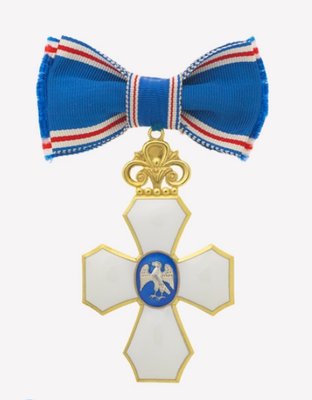
The next class above Knight's Cross is Commander's Cross. The cross of Commander's Cross is larger than that of Knight's Cross, and the ribbon is also broader. Commanders wear the Order of the Falcon on a ribbon around the neck. In the case of men, the insignia is worn close under the knot of the necktie.
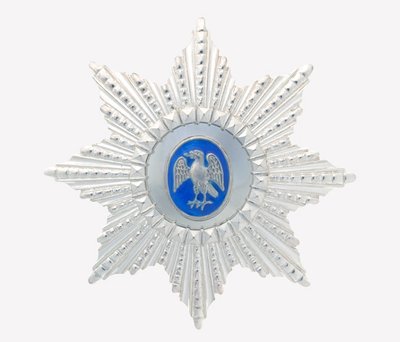
Commander's Cross with Star
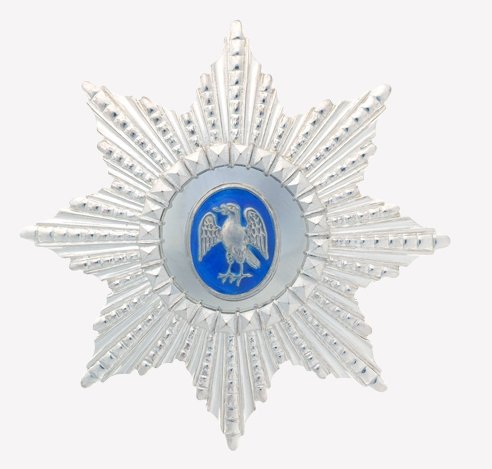
The next class above Commander's Cross is Commander's Cross with Star. The Star is an eight-pointed silver star, and in its center is a blue-enamelled silver shield bearing the silver falcon. A Commander of this class wears the Cross around the neck and the Star on the left side of the chest.

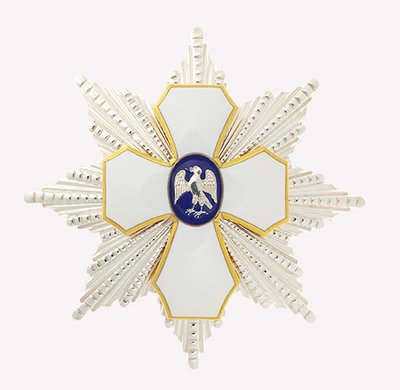
Grand Cross
The next class above Commander's Cross with Star is Grand Cross. A Grand Cross Knight wears octagonal silver star with the cross insignia on the left side of the chest, and the Grand Cross on the right hip on a sash. In the case of men, the Grand Cross sash is worn under the tailcoat but over the waistcoat.

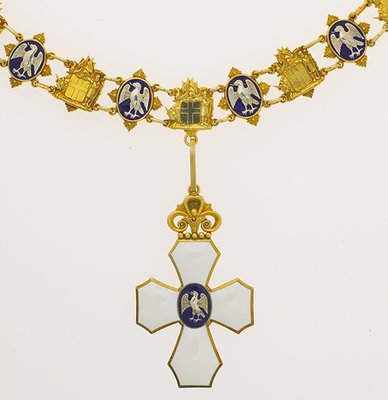
Chain of Grand Cross Star
The highest insignia of the Order of the Falcon is the Chain of Grand Cross Star, which the Grand Master of the Order alone bears among Icelanders, and only while serving as President of Iceland. The President may also bestow Chain of Grand Cross Star upon heads of state of other countries. The Chain is composed of blue-enamelled shields with silver falcons and the coat of arms of the Republic of Icelandi alternating, and from it hangs the Grand Cross. The holder of the order wears the Chain together with the Grand Cross Star (without the order sash).

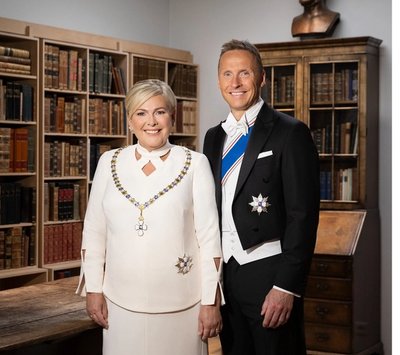
When to wear the Order of the Falcon
The Order of the Falcon is worn with evening dress, long gowns or the state’s formal uniforms at ceremonial events where the head of state is present and the wearing of decorations is requested. Recipients may also wear the Order of the Falcon with dark suits or formal attire on other occasions, such as on the National Day, New Year’s Day, Seamen’s Day or other festive days, at regional celebrations or on personal special occasions. The same applies to those recipients who wear the official uniforms of the Icelandic state.
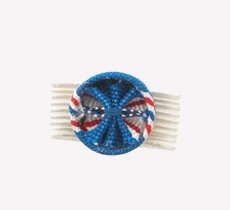
Rosettes of the Order of the Falcon
Every grade of the Order of the Falcon comes with a special badge, a rosette. It indicates the grade of the order that the recipient has been awarded. The rosette is worn on the left side in the buttonhole of the lapel and in the corresponding place on women’s clothing. It may be worn with a suit and comparable women’s attire whenever the recipient finds it appropriate. (The text on this page is based on the presidential decree concerning the order, as well as on Birgir Thorlacius’s book, Íslensk heiðursmerki (Icelandic decorations), published in 1999.)